

By a thin though unassailable margin (49.65% vs. 48.7%) Colombian voters elected as president Abelardo de la Espriella, a political novice and former defense attorney whose platform is seen as a mix between that of Argentina’s Javier Milei and El Salvador’s Nayib Bukele. De la Espriella defeated Marxist senator Iván Cepeda, sitting president Gustavo Petro’s dauphin and a long-time ally of the Revolutionary Armed Forces of Colombia (FARC).
While the ruling hard left expected this defeat—Petro even felt the need to participate directly in the campaign, which is illegal according to the Constitution—De la Espriella’s initial victory in the first round of voting, held on May 31, took them fully by surprise.
Petro, a former guerrilla group member and Hugo Chávez advisor, was expecting Cepeda to win first place comfortably. Most old opinion polling firms had Cepeda in first place and the opposition was divided between the traditional “centrist” candidate, Senator Paloma Valencia, and De la Espriella, the surging outsider.
Contrary to conventional wisdom, De la Espriella managed both to defeat Cepeda— with a solid margin of 3% (44% to 41%)— and to leave Valencia and the establishment in the dust with under 7% of the vote.
Not that everyone was surprised. Brazilian polling firm Atlas Intel, the tech-heavy, new kid on the block, had shown De la Espriella’s strength for months. It even suggested as early as February that he could beat Cepeda in the run-off, which takes place between the top two candidates when neither obtains over 50% of the vote in the first round. In typical Colombian fashion, the state (National Electoral Counsel) turned against Atlas and even suspended the firm from publishing polls (Uber, likewise precise and popular, is still technically illegal in the country). Atlas turned out to be the most accurate pollster.
It was only after May 31 that the left realized a De la Espriella victory was a distinct possibility. As so-called progressives panicked, they decided to make the entire election turn around, well, me.
It turns out that, in July of 2025, I published a Substack post with a detailed plan to cut public spending by 4% of GDP. It involves eliminating, merging, or privatizing 136 government agencies, including 13 of 19 ministries (among them Equality, Culture, and Sports) and a series of likewise useless outfits, such as state-owned car mechanic shops, a real-estate company, and a fund that subsidizes struggling filmmakers (as Milei says, “if you depend on state handouts to make a living from art, you are no artist, but rather a government official”).
Initially, my document did generate some interest on social media, especially after 10AmPro, a libertarian-leaning investment podcast based in Medellín, interviewed me about it. Some time later, in September, I managed to speak to De la Espriella, then an emerging and underestimated candidate, who proceeded to vouch for the plan on X and called it a potential “roadmap” for his campaign, which promised to cut back the state by 40% (without going into much detail on how to do so).
This generated some backlash from the left. In one viral video, a Maoist influencer said that De la Espriella wanted to dismantle the state and referred to me as “a fanatical extremist who follows the doctrine of Murray Rothbard, one of the darkest characters of the American extreme right.” But the subject remained rather mooted thereafter. The campaign rolled on and I continued to support De la Espriella on social media without being a formal spokesman or a member of his team.
After the May 31 election, though, the left blazed all its rhetorical guns—luckily not its real ones—against my state reduction scheme. One left-wing legislator posted a video calling me De la Espriella’s advisor and warning of massive unemployment if my plan came to fruition. Some days later, a labor union, the Central General de Trabajadores, announced a protest against my plan and in defense of “public employment” (Colombia, incidentally, has a 60% informality rate due to rigid labor laws and high minimum wages; state employment is a privilege!)
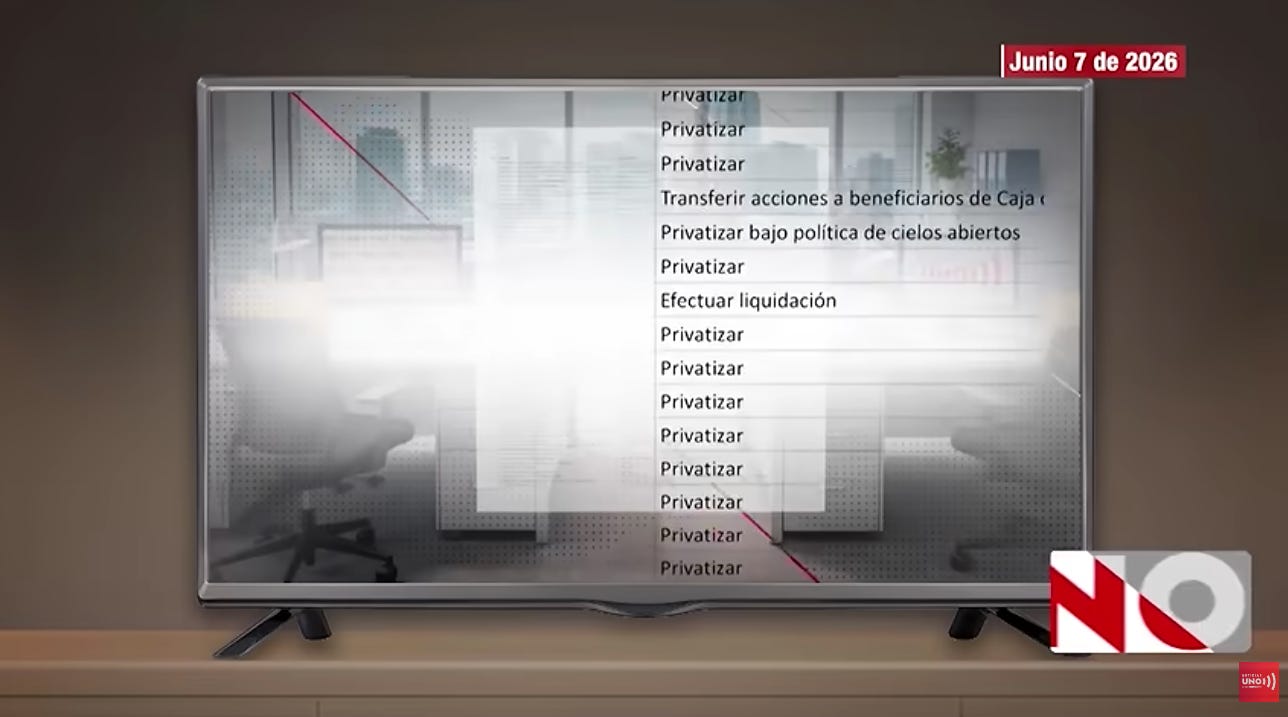
Other far-left, pro-Petro members of Congress dishonestly showed screenshots of my Substack’s Google Doc attachments as if they were official De la Espriella campaign documents, even though the campaign itself never published them. Noticias Uno, a left-wing news channel, did the same in a 2.5 minute segment, displaying my attachments while claiming they had scooped internal campaign files (although my Substack post had been public for 11 months).
When I asked the channel to rectify for showing my work without proper credit, a Noticias Uno journalist responded by tweeting: “we never say the proposal is not yours.” After I ridiculed such logic—as if plagiarism only applied when the guilty party specifies it is not plagiarizing the source— Noticias Uno broadcast another segment, in which the channel’s director himself doubled down on the official campaign document theory. He further claimed I had no need to complain since they had obtained their information—identical to my published work— “from an anonymous PDF file” which, they had verified, did not originate from my computer. Good to know they had such rigorous standards to verify sources, I replied.
But the most unhinged attack came last week from Carlos Carrillo, a China-trained communist and former Petro official— he ran an agency that I propose to get rid of— who recently quit his post to campaign for Cepeda. In an interview with María Jimena Dussan, a left-wing journalist, Carrillo said that anarchocapitalism is a most dangerous, authoritarian threat to Colombia, and that it is spearheaded by libertarians fond of von Mises, Hayek, and Rothbard— “especially Rothbard,” he warned gravely. While these eccentrics were an insignificant group (grupúsculo) a few years ago, he claimed, they are now dangerously close to seizing power to end the state.
Carrillo then points to me specifically as a mere “curiosity” some years back, but who now may well become De la Espriella’s finance minister, the head of the Department of National Planning (a dirigiste, Gaullist-France-inspired entity), or even a member of the board at the central bank. All of which goes to show, Carrillo tells Dussan’s “well-inforned audience,” how far Colombia can descend down the anarchocapitalist abyss.
Of all the nominations to high office—flattering perhaps if, unlike me, one is bureaucratically inclined— I find the central bank idea most absurd (although the planning department is a close second). It is yet another state monopoly I find superfluous, having argued for years that Colombia should adopt the superior, low-inflation Panamanian model of monetary freedom, with no central bank and no legal tender. This is another proposal, by the way, to which De la Espriella is sympathetic—dum spiro, spero—and which the left sought to weaponize during the run-off, not realizing it was rather popular.
Until a few days ago, I never thought that it was politically possible in the short-term to drastically rein in the Colombian state and dollarize the economy, even if done partially with the onshore USD-denominated bank accounts that De la Espriella proposes. But since leftists decided to turn the run-off into a referendum on cutting the bureaucracy— with me as a protagonist— and greater monetary freedom, there is now a popular mandate for both. I cannot thank them enough.
Excelente, Daniel. Creo que no necesitamos un “DOGE”, pues para cortar burocracia no hay necesidad de crear una agencia.
Sí sería ideal que usted los asesore en qué cortar, una consultoría por resultados. 70 billones año es poco ahorro para el despilfarro que tenemos acá.
Ya lo leí, escribí otro